
Phinisi Build Bali: From Bulukumba Sand to First Charter
A phinisi build Bali owners commission follows a long, well-marked arc: a brief agreed at a chart table, a keel laid on open sand at Tanjung Bira in South Sulawesi, a hull raised by hand, a launch, a delivery passage across the Flores Sea, commissioning in Bali, and a first charter season in Komodo. Plan on two and a half to three and a half years, brief to first guests.
What follows is the whole route, phase by phase. Our group has arranged builds, deliveries, and charter programs through its operating brands since 2015, so the timeline below reflects how these projects actually run.
The brief: decisions made before any timber is cut
Every sound build starts with a use case, not a drawing. Private cruising and commercial charter lead to different boats. Cabin count, crew quarters, dive compressors, tender stowage, and generator sizing all follow from how the vessel will earn its keep.
The flag question is settled here too. Commercial charter inside Indonesian waters requires an Indonesian entity, typically a PT PMA, plus operating licenses, and cabotage rules favor Indonesian-flag vessels. That is a core reason the high-end charter phinisi working Komodo are locally built and Indonesian-flagged rather than imported. Treat this as general information, not legal or financial advice; verify current requirements with licensed agents before committing capital.
Naval architecture, the general arrangement, and a build contract with staged payments close out this phase. Our phinisi yacht construction desk typically spends two to four months here with an owner before anyone touches timber.
Keel on the sand: where a phinisi build Bali actually begins
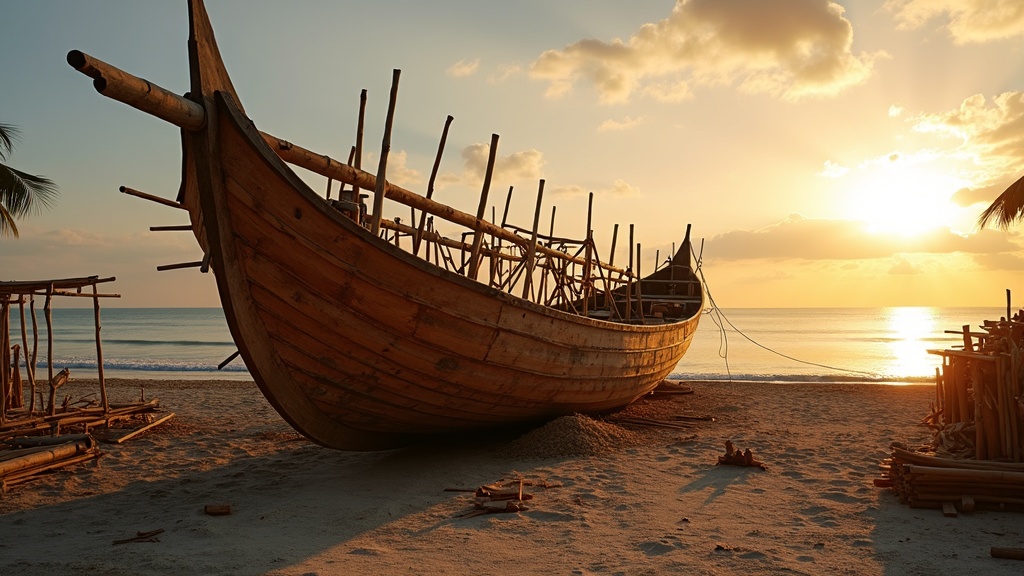
The hull does not start in Bali. It starts on the beaches of Bulukumba Regency, South Sulawesi — Tana Beru, Bira, and Lemo-Lemo — where the Konjo boatbuilding community has raised wooden ships for generations. UNESCO inscribed this tradition, the art of boatbuilding in South Sulawesi, on its Intangible Cultural Heritage list in 2017.
There is no shed and no slipway. A 30 to 50 meter hull rises in the open, plank by plank, held in wooden scaffolding with the tide line a short walk away. Yards working in this tradition favor dense tropical hardwoods — Ulin ironwood below the waterline, Bitti for frames — sourced and seasoned before the keel goes down.
For the owner, this is the longest and least visible stretch of the project. Progress is measured in strakes, not press releases. Good yards send regular photo documentation; better ones welcome the owner on the sand.
A realistic timeline, phase by phase
The sequence below is honest arithmetic for a 30 to 45 meter charter phinisi; timber availability, monsoon weather, and change orders are the usual sources of drift.
| Phase | Typical duration | Where it happens |
|---|---|---|
| Brief, design, and contract | 2–4 months | Chart table, anywhere |
| Timber sourcing and keel laying | 2–3 months | Bulukumba |
| Hull raising on the beach | 12–18 months | Tanjung Bira shoreline |
| Launch and fit-out afloat: machinery, systems, interior | 8–14 months | Bira and fit-out berth |
| Sea trials and snagging | 1–3 months | South Sulawesi waters |
| Delivery passage to Bali | About a week, with weather margin | Flores Sea, Lesser Sunda chain |
| Commissioning, licensing, crew work-up | 2–4 months | Bali |
Add it up and two and a half to three and a half years from brief to first paying charter is the honest answer. Any quote promising a 40-meter boat in twelve months deserves hard questions before it deserves a deposit.
Launch day
Launch at Bira is a community event with ceremony attached. The hull comes down the beach on rollers and timbers at a favorable tide, with lines, manpower, and accumulated local judgment doing the work a travel lift would do elsewhere. Owners who attend rarely regret the flight.
The hull goes in largely bare. Engines, generators, tankage, wiring, and the interior are commonly completed afloat after launch, which is why the fit-out line in the table above carries as much weight as the hull itself.
The delivery passage: Bira to Bali
With trials complete, the boat makes its first real voyage: out of the Gulf of Bone approaches, across the Flores Sea, and along the Lesser Sunda chain to Bali. Allow several days at sea plus a weather margin; delivery crews treat schedules as intentions, not promises.
The passage doubles as a shakedown. Engine hours accumulate, fuel burn gets measured against the builder’s estimate, the steering and pumps get their first sustained test, and the crew learns how the boat behaves with a sea on the quarter. The snag list written on this passage sets the agenda for commissioning.
Commissioning in Bali: paper, crew, and a program
Arrival in Bali opens the administrative leg: registration and survey under the Indonesian flag, safety equipment sign-off, insurance placement, and, for charter vessels, the licensing that lets the boat trade legally. Again — information, not legal advice; good licensed agents earn their fee here.
Commissioning is also where the boat becomes a business. Crew hiring and work-up, maintenance schedules, spares inventory, compliance renewals, and a charter calendar all need an owner’s decision or an owner’s delegate. Our yacht management desk runs exactly this scope.
Charter brokers book what they can see, so photography, a fleet film, and disciplined listing copy belong in the commissioning budget, not the afterthought column — work our yacht media production team handles.
Bali’s berthing picture is changing as well. On Serangan Island, the marina inside the Kura Kura Bali SEZ — reported at around 146 yachts, with main works underway since April 2025 and a phased opening from 2026 — is under construction roughly fifteen minutes from the airport. Our marina desk tracks that progress; we are an independent information and yacht-services platform, not the marina operator, and we never promise berths.
First season in Komodo
The Komodo season runs May through September, and a boat commissioned in the early months of the year can meet it. The classic route builds eastward: Bali, Nusa Penida and Lembongan, Lombok and the Gilis, Sumbawa, then the Komodo National Park anchorages. Typical published broker ranges for boutique phinisi of 30 to 45 meters sit around US$35,000 to US$80,000 per week in high season, before expenses and park fees; larger luxury builds list higher. Our own rates are on request via WhatsApp.
A well-run first season proves the boat, the crew, and the calendar; bookings firm up in year two. Come October, fleets reposition toward Raja Ampat for the October-to-April season, and the annual cycle that justifies the whole build begins. Our Komodo charter desk places new vessels into this market, and structured liveaboard phinisi charter programs keep them earning across both seasons.
FAQ
How long does a phinisi take from brief to first charter?
A realistic phinisi build Bali program runs two and a half to three and a half years: months of design and contract work, twelve to eighteen months of hull raising at Tanjung Bira, eight to fourteen months of fit-out afloat, then trials, the delivery passage, and commissioning in Bali before the first Komodo season.
Why are charter phinisi built in Indonesia rather than imported?
Cabotage rules favor Indonesian-flag vessels for commercial work inside Indonesian waters, and permanent import of a foreign yacht attracts duties, VAT, and possibly luxury sales tax. Building locally with Indonesian yards and flagging the vessel in Indonesia is the established route for charter operations. This is general information, not legal advice; confirm specifics with licensed agents.
Can the owner visit the yard during the build?
Yes, and it is encouraged. The Bulukumba beaches are working yards, not closed facilities. Most owners visit at keel laying, once or twice during hull raising, and again at launch. Between visits, a disciplined yard documents progress in photo and video.
What does the delivery passage from Bira to Bali involve?
A passage of several days across the Flores Sea and along the Lesser Sunda chain, run by a delivery crew with a weather margin built in. It doubles as the boat’s first sustained shakedown, and the snag list it produces sets the commissioning agenda on arrival in Bali.
What can a new phinisi earn in its first Komodo season?
Typical published broker ranges put boutique 30 to 45 meter phinisi at roughly US$35,000 to US$80,000 per week in high season, with expenses, APA, and park fees on top. Actual results depend on the boat, the crew, the media package, and how early the calendar opened. Rates for our own fleet and programs are on request via WhatsApp.
Who runs the boat after delivery?
Either the owner’s own team or a management company. Management covers crew payroll and training, maintenance and spares, compliance renewals, insurance, and the charter calendar. Many first-time owners delegate the lot for the first two seasons.
Talk to our yacht desk
From a brief on paper to a keel on the Bira sand to a first Komodo season, our group has run this arc since 2015. One WhatsApp thread covers charter, construction, transfers and everything in between.