Biosecurity at Bali Marinas: Hull Cleaning Before You Arrive
The short version: Indonesia does not yet run the hard-edged biofouling regimes of New Zealand or Australia, but arriving in Bali with a clean hull is still the professional standard — and increasingly the practical one. The reef-and-lagoon shelf around Serangan and the Benoa basin is a living ecosystem inside a marine-tourism economy, quarantine attention on visiting vessels is rising year on year, and a fouled hull complicates everything from your clearance conversation to your first haul-out booking. Boats that treat hull cleaning as part of passage planning — done before arrival, documented, and logged — slide into Bali without friction. Boats that arrive trailing six months of growth inherit a problem that is harder to solve here than almost anywhere else on their route.
Disclosure, as always: kurakuramarina.com is an independent information and marine-services platform covering the Serangan–Benoa waterfront. We do not operate the marina basins we write about, and nothing here replaces the instructions of port authorities or quarantine officers. What our desk does is coordinate the practical side — divers, yards, paperwork — so the biosecurity question is answered before it is asked.
Why Biofouling Matters in Bali Specifically
Three reasons, in rising order of consequence. First, ecology: the waters between Serangan, Benoa and the Badung Strait carry coral, seagrass and an active turtle-conservation story, and translocated fouling organisms are a genuine vector for invasive species. Second, regulation: Indonesia is a signatory culture to the IMO’s biofouling guidelines, and while enforcement remains discretionary, quarantine (karantina) officers in a post-CAIT clearance environment have wide latitude to inspect and to make a dirty hull expensive in time. The clearance frame is covered in our post-CAIT clearance guide. Third, pure self-interest: Bali’s haul-out capacity is finite and slipway-based, as our haul-out and dry dock guide explains — if your fouling problem needs lifting out to fix, you are joining a queue that services an entire charter fleet.
The Standard to Arrive With
The working benchmark our engineers give owners is simple: slime layer acceptable, macro-fouling not. In practice that means:
- Hull: antifouling active and continuous, no barnacle colonies, no weed skirt at the waterline, no mussel growth in sheltered pockets.
- Niche areas: the places inspectors and surveyors actually look — sea chests, bow and stern thruster tunnels, prop shafts and brackets, trim tabs, transducers, anode studs and the rudder root.
- Anchor and chain: washed down before arrival; mud from your last anchorage is exactly the biological cargo the rules exist to stop.
- Records: a biofouling management plan and a cleaning log, even a simple one. Two photographed hull inspections a year and receipts for your last clean answer most official questions before they harden.
Cleaning Before You Arrive — the Honest Options
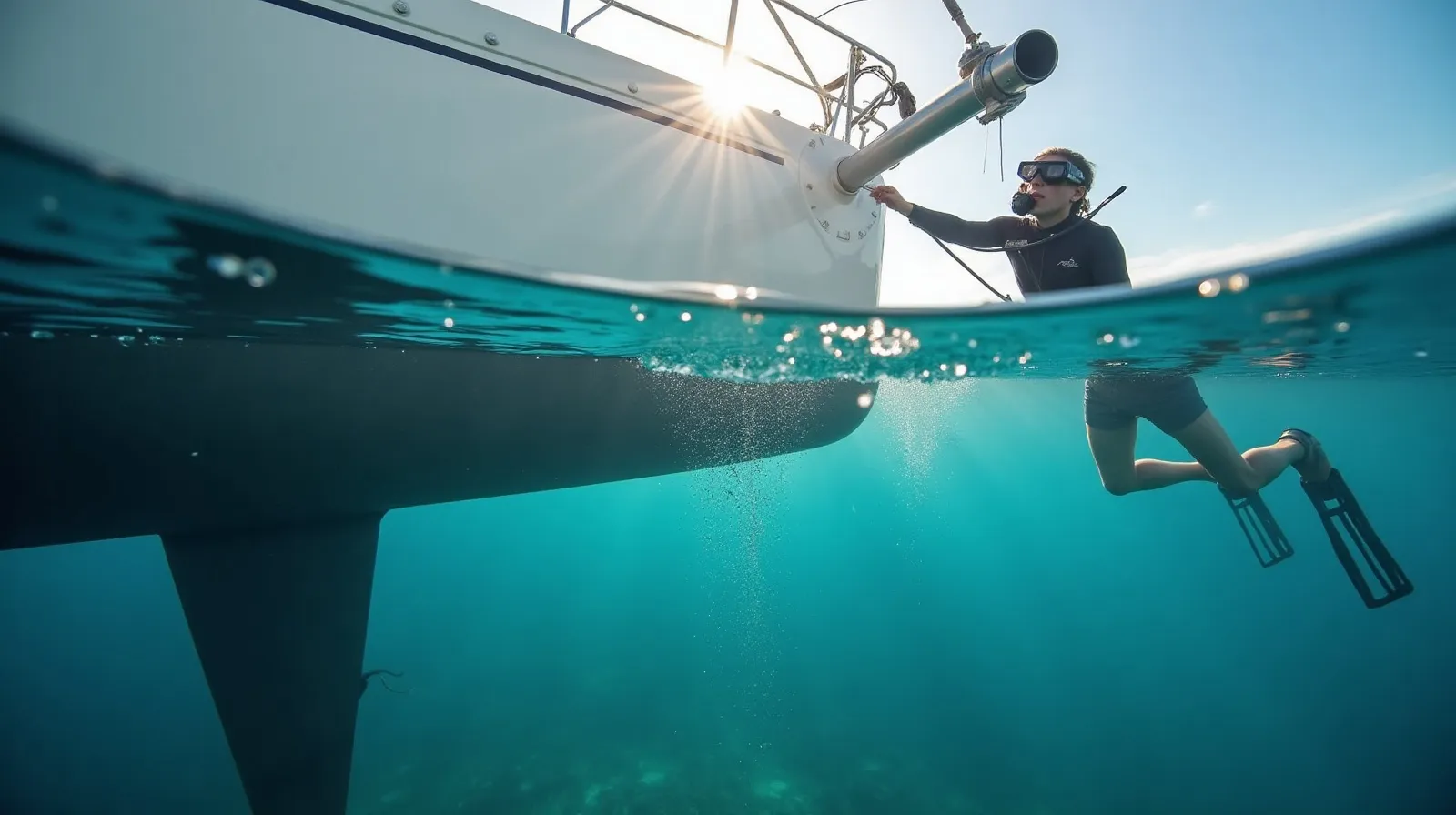
The best place to deal with fouling is your previous port, not your next one. A pre-departure dive clean in Darwin, Cairns, Singapore or Phuket is routine and competitively priced; the same job in Bali is possible but supply is thinner. If the passage itself is long enough to re-foul a marginal hull, plan the clean for the last practical stop. Arriving via the eastern route from Australia, note that the hard part of your biosecurity year was the Australian side; keep the standard you left with. For boats already in Indonesian waters, an in-water clean at anchor by local divers is the normal mechanism — our marine services desk arranges hull dives around Serangan with photo reports, and for anything the divers cannot solve afloat, berth-plus-yard coordination is the next step up.
What In-Water Cleaning Can and Cannot Do Here
In-water cleaning in Bali is a soft-wash discipline: slime, early weed and scattered barnacles come off; failed antifouling does not. If the coating is at end of life, cleaning buys weeks, not seasons, and the real answer is a repaint — which on this island means a slipway, mobile crane or tidal grid for vessels up to roughly 25–30 metres, and a repositioning to Batam or Singapore for anything larger. Budget honestly: a dive clean runs to a few hundred US dollars for a cruising yacht depending on length and state; a full antifoul cycle is a yard project priced in the thousands. The arithmetic favours keeping the coating alive with regular light cleans rather than letting growth force the yard question — and it keeps you off the emergency list described in our emergency haul contacts guide.
Timing It With Your Arrival
Fold biosecurity into the same planning pass as your channel and berth logistics. A boat that arrives clean, clears smoothly and berths without a fouling caveat can take fuel, provision and start its Bali season immediately; the sequencing details live in our notes on arrivals after dark and the practicalities of a handover-style stop in yacht deliveries via Bali. Fleet operators formalise all of this — Komodo Luxury’s fleet network, the group behind this desk at komodoluxury.com, runs scheduled hull inspections precisely so that no boat ever meets a season, a surveyor or a quarantine officer with a dirty bottom. A private yacht can adopt the same calendar for the cost of two dives a year.
Does Indonesia have formal biofouling rules like New Zealand or Australia?
Not at that level of codification as of 2026. There is no published clean-hull threshold with turn-away powers of the New Zealand type. But quarantine officers have broad discretion during clearance, attention to biofouling is rising regionally, and the IMO guidelines are the reference standard. Arriving clean, with a simple management plan and cleaning log, is the professional norm and removes the discretion risk entirely.
Can I get my hull cleaned in Bali after I arrive?
Yes — in-water dive cleaning around Serangan and Benoa is available and can be arranged with photo reports through a marine-services desk. The honest caveat is capacity: Bali’s dive-clean and haul-out supply serves a working charter fleet, so book rather than show up hoping. Failed antifouling cannot be fixed by cleaning; that becomes a slipway job up to roughly 25–30 metres, or Batam/Singapore beyond that.
What parts of the boat do inspectors and surveyors check first?
Niche areas, not the flat hull: sea chests, thruster tunnels, prop shafts and brackets, trim tabs, transducers and the rudder root, plus the anchor and chain for residual mud. These are where growth survives cleaning and where translocated organisms actually travel. A clean waterline with fouled niches is still a fouled boat.
How much does a hull clean cost in Bali?
Indicatively, a diver-led in-water clean for a cruising yacht is priced in the low hundreds of US dollars, scaling with length and growth state. A full repaint is a separate yard project in the thousands, constrained by Bali’s slipway-class lift capacity. Regular light cleans are the economical strategy; letting growth accumulate until the yard question forces itself is the expensive one.
Talk to our yacht desk
Tell us your arrival window and last clean date, and we schedule the dive, the photo report and any yard follow-up in USD in writing — one WhatsApp thread, hull ready before the season starts.